What Do You Know To Be True?
"What Do You Know To Be True?" is a series of conversations with ordinary people about their extraordinary talent and the meaningful impact it has on others. The invitation is to be inspired to discover your superpower, unlock your potential and possibilities, and make meaningful impact in the world.
The journey to unlocking one’s potential and possibilities includes a discovery and deepening of understanding of the building blocks of human potential: purpose, joy, hope, adaptability, well-bring, courage, and community.
Our host, Roger Kastner, seeks to discover more about our guests' path to discover their superpower and unlocking their potential by exploring their journey and the insights and wisdom they learned along the way.
The goal of these conversations is not to try to emulate it or “hack” our way to a new talent. Instead, these conversations are meant to help us think deeply about our own special talents, how we discovered them, why we continue to develop them, and what it’s like to use them to create meaningful impact in service of others.
This podcast is for people leaders, coaches, org development practitioners, mentors, and anyone who works with other people in their pursuit of unlocking their potential and achieving more.
Our guests bring humility, vulnerability, gratitude, and humor as they delve deep into their experiences and share their insights and wisdom. A common thread in these conversations is how our guest use empathy, curiosity, and connection to amplify the impact of their superpowers. They are ordinary people, with extraordinary talent, who make a meaningful impact in our world.
Enjoy the conversations!
#DiscoverYourSuperpower #UnlockYourPotential #MakeMeaningfulImpact
What Do You Know To Be True?
Discover the Superpower of Connection…Without Burnout
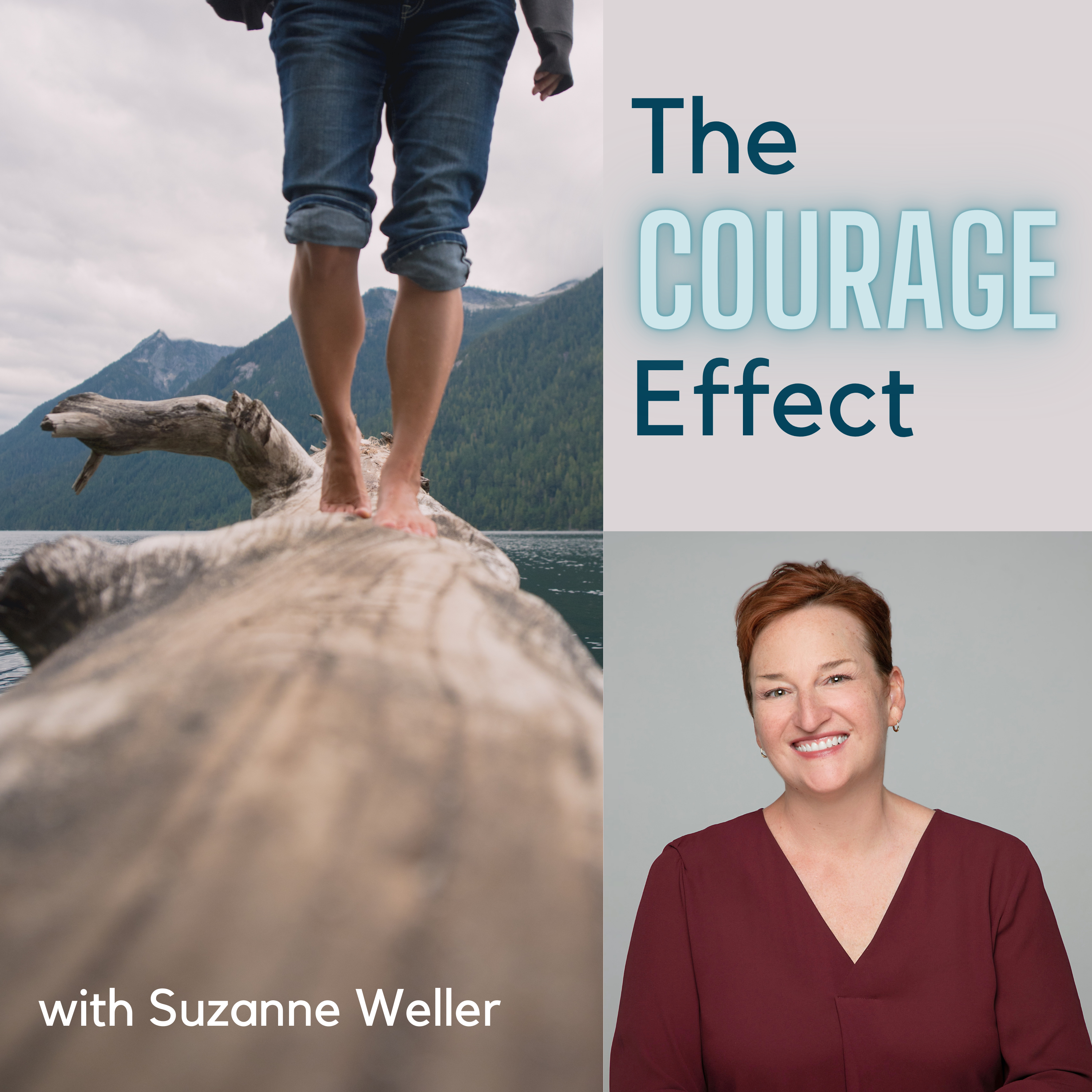
This is a conversation with Suzanne Weller and how she discovered her superpower of being a connector and a community builder, to unlock her possibilities, and the surprising truth of what allows her to make meaningful impact with the colleagues and communities she engages.
When it comes to being a connector and a community builder, can you think of a capability more important than being able to read other people and read a room?
For Suzanne Weller, there’s something she’s learned to be even more important than reading other people which has helped her grow her superpower and her impact.
As a leadership coach, a public speaker, a storyteller, a founder of her own consulting firm, and host of The Courage Effect podcast, she has a lot of experience being able to read people and rooms.
But that is not the most valuable skill she’s learned as a connector and a community builder.
In this conversation, we dive into…
➡️what being a connector and community builder does for Suzanne
➡️the costs of being a connector and a community builder
➡️if you are saying ‘yes’ to one thing, what are you saying ‘no’ to?
➡️what it takes to be a better team mate and better community member.
*** Don't miss another episode with amazing guests l- subscribe here: https://www.youtube.com/@WDYKTBT?sub_confirmation=1 ***
In this episode, Suzanne answers the following questions:
➡️How do I become a connector?
➡️What makes someone a good connector?
➡️How do I build a community?
➡️How to build community when you feel isolated?
My favorite quote from the episode: “It’s the trade-off idea. If you say ‘no,’ then you get to say ‘yes’ to something else. And if I say ‘yes’ to this, I have to say ‘no’ to something else.”
Suzanne is speaking to the need to find a balance in commitments and agreements, and how easy it is as an extrovert, a connector, and a community-builder to over-extend oneself. Even if it’s a superpower, operating out of balance is the fast lane to burnout.
Resources mentioned in the episode:
▶️Suzanne’s company Weller Collaboration
▶️Suzanne’s LinkedIn
▶️Podcast: The Courage Effect
▶️Book: “The Lion Women of Tehran" by Marjan Kamali,
Music in this episode by Ian Kastner.
"What Do You Know To Be True?" is a series of conversations where I speak with interesting people about their special talent or superhero power and the meaningful impact it has on others. The intention is to learn more about their experience with their superhero power, so that we can learn something about the special talent in each of us which allows us to connect more deeply with our purpose and achieve our potential.
For more info about the podcast or to check out more episodes, go to:
https://www.youtube.com/@WDYKTBT?sub_confirmation=1
"What Do You Know To Be True?" is hosted by Roger Kastner, is a production of Three Blue Pens, and is recorded on the ancestral lands of the Duwamish and Suquamish people. To discover the ancestral lands of the indigenous people whose land you may be on, go to: https://native-land.ca/
Keywords
#DiscoverYourSuperpower #UnlockYourPotential #UnlockYourPossibilities #MakeMeaningfulImpact
Transcripts – The Surprising Truth About Being A Connector And Community Builder
Keywords
#DiscoverYourSuperpower #UnlockYourPotential #UnlockYourPossibilities #MakeMeaningfulImpact
[Roger]
When it comes to being a connector and a community builder, can you think of a capability more important than being able to read other people and read a room?
For Suzanne Weller, a leadership coach, public speaker, storyteller, founder of her own consulting firm, and podcast host, she has a lot of experience being able to read people and read rooms. But there's something she's learned to be even more important than that which helped her grow her superpower and the impact it has with others.
In this conversation, Suzanne shares what she knows to be true about her superpower of being a connector and a community builder. Additionally, we dive into what it takes to be a better teammate and be a better community member. Hi, I'm Roger Kastner and welcome to the What Do You Know To Be True? podcast.
The invitation in these conversations is to become inspired from our guests and their experiences with their superpowers so we can go discover more about ourselves and our special talents and live more into our possibilities. If you're ready, let's dive in.
Hey, Suzanne, thank you for joining me today. I'm excited to have this conversation with you.
[Suzanne]
So happy to be here, Roger. Thanks for having me.
[Roger]
Before we jump into this conversation about your superpower of being a connector and community builder, what is important for us to know about you?
[Suzanne]
I like to introduce myself with a phrase that my husband coined, which is, I am American-made British parts. My parents are from England. My parents came over to this country on the Queen Mary after getting married and found their life here.
That was one of the things that they really just anchored my sister and I both on from a very young age, was find your path, like strike your own path. That has been something that I think has really influenced me since I was a young girl was the idea that you can do anything you want to, just go out and try it. I think that that's just something about me in general.
I really like to experiment. I like to try things. I like to be courageous and to really, to be able to spark that in others.
And a big part of that is how I was brought up. I was very fortunate.
[Roger]
I love how you just mentioned the word courageous, because I first came about learning about you when a mutual friend, Colleen Chardos, told me that you are the host of the Courage Effect podcast. We were talking about, of course, I was talking about my podcast and I was telling her, like we do, and I was telling her about the pillars of possibilities. And I mentioned one of those pillars being courage.
And she's like, oh, you got to talk to Suzanne. Well, boom, she connected us. I love how our connector connected us.
And based on that, through our conversations and the invitation to have you on this podcast, I just assumed, weak spot of mine, I assumed we were going to be talking about your superpower of courage. But no, you surprised me the other day when you said your extraordinary talent is being a connector and community builder. And when I look back, I'm like, yeah, no, I've benefited from all the people you've connected me with, from the communities that you build and invite me into.
And so I see it and I've benefited from it. So first, thank you. Second, tell us a little bit more about your superpower of being a connector and a community builder.
[Suzanne]
I am an extrovert, like let's just say that. So I have that. I have that working for me, but I sometimes potentially have that working against me.
But for me, so much of my happy place is when I'm in community with other people or another person. And there is just that sense of connection of what I'm able to experience with somebody in that moment. It takes me to a different place and it allows me to see things that I wouldn't see on my own.
And that's really beautiful. And that, to me, is the opening of possibility. And that's probably going back to my parents coming to this country from another place and figuring it out.
And I think it's, who are the people? You can't do it alone. Who are the people that you can partner with and learn from and to get out of your own way?
Because even though it's wonderful to be courageous and it's wonderful to bring your superpowers and everything that you are capable of to the world, so much of that isn't possible without others. And it's not fully realized until you're able to do it with others. So that, for me, I think is how it lights me up.
And it's like blood in my veins. It's just a part of me.
[Roger]
None of us achieve success alone. One of the building blocks of living into our possible selves or potential that I have come to add to the framework of this podcast is around community and team. And there's so much content out there about how to be a good leader.
And yet there's a dearth of content around how to be a good team member, how to be a good community member. So I'm very curious to learn from you. What have you learned to be true about becoming a good team member or community member?
[Suzanne]
A lot of what I've learned is that I think it's important to differentiate between what's a team and what's a community and what's a group. There's different goals. There's different purposes that they serve.
So the idea of what you're bringing to it and what you're getting from it, that symbiotic relationship, I think is all a part of why are you there? And that can be very different if it's a team at work that has, hopefully, or a team in general that has a shared, clear goal. So if you're working towards something together, then there's other aspects, obviously, that go along with this.
And you know this based on your organizational work. But it's the idea of why are you really there? And I think with community, there are various places that you tap into, but your purpose might be different from other people's that are in that community as well.
So how do we have, I think, honesty and clarity around what do we want to give and receive from the various communities that we tap into? That to me is something that I spend quite a bit of time on because I have a tendency, I also have a tendency to overconnect. And that means that because I love being with people and I love connecting, however, it can be an Achilles heel for me of sorts because I can give so much to being with other people or to being in connection that sometimes I might sacrifice myself in exchange for doing that.
And I have to strike a balance of what makes sense with this connection for me. I know I want to do it, but is it really generative? Is it giving me and that person what we both need?
And it doesn't mean that I'm doing that with every single exchange that I have every day. But if we're truly talking about community and what I want to give to it and what I want to receive from it, I think just being honest with myself and having a clear idea of what that means to me allows me to better assess and discern what I give to it. How much time, energy, and attention?
I always say those are your three most precious resources. Where am I going to pay it? Where am I going to give it?
Where am I going to maybe be a little bit more diplomatic or pull back if it makes sense? And also the same for other people. If they're there in community with me in some way, I mean, sometimes there's more structured relationships, what do they get out of it?
And how can I have clear expectations for them as well as for myself?
[Roger]
I love that distinction that you make between team and community. Because I think with teams, the vision or the goals are usually relatively clear, but not always. In communities, you see community involvement, whether in real life or online.
It seems like a lot of members have this arc to their participation. What makes sense to me, based on what you're saying and my own experience, is that arc is people get really excited about being a part of that community and they realize at some point, oh, we don't have the same goals. We don't have the same purpose.
And I'm no longer getting that thing that I was hoping to get out of it. And now my participation wanes. Have you had a similar experience with that level of participation?
[Suzanne]
Yes, definitely. And I think that goes for teams and for communities. Going back to the whole idea of time, energy, and attention.
If there's one thing that age has taught me, it's the wisdom of knowing that I've limited time on this planet. I've limited time to be with the people that I love. And I've had a lot of friends and family members struggle with cancer and other things over these past few years.
I've lost some very dear people in my life. And if anything, it just makes me anchor more and more firmly into, I'm here now. Let's do this now.
I do want to get value out of every day, but that doesn't mean that I'm going to also suck myself dry in the process of doing it. But it's just the reality of what really matters to me and being more honest with what I want and what I don't want. And how many Fs do I have to give?
That's also one of the beautiful things about age. But I want to be with people that I trust and that respect. And that's a huge part of a team and a community is how do we have those foundational needs that allow us to interact with each other with psychological safety, with just clear understanding and clear communication and otherwise around what we want and what we don't want, and what we're willing to give and what we're not.
[Roger]
I know as a leadership coach, you do a lot of contracting with your clients. And what I'm hearing you say, the wisdom that's coming forth is contracting with communities of why are we here? How are we going to interact?
What are the do's and don'ts? And just making sure we're on the same page. And if we're not, cool, we'll bounce.
If we are, the time's going to be so much more precious and sacred.
[Suzanne]
Yes. And I love that you're bringing it back to contracting. I mean, I think one of the scariest moments for me as a coach, and I'm not sure if you've had this, is when I was coaching somebody and we weren't going anywhere.
The conversation, it was just vacuous. And I could tell he didn't really want to be there. And it took so much courage for me to say, do you want to be here right now?
Is this valuable time? Because I can give it back to you. Like 15 minutes into an hour long session, just saying, I don't want to waste your time.
And is this the best use of your time? Is this the best use of my time? And those were the moments that was really scary for me to do, especially when you're talking about senior executives in companies and basically saying, you're not telling somebody they're wasting your time, but you just want to have that honest conversation.
And that for me is, that's I think where that courage comes into. It's the opportunity to just say like, why are we here?
[Roger]
Straight up. In a few weeks, I'm going to give a talk on what it takes to become a trusted advisor. And this framework actually came from a client of mine who shared this framework with me once I became a trusted advisor with him, but I didn't know the steps.
The third step is look out for my blind side. And he would say, tell me something that I don't know, but you know, tell me something my people might tell me, but they're afraid to tell me. And I might fire them.
Tell me something I might fire you about, but it's still true. And what I hear in that story was that you just made a deposit in the trust bank by telling that leader, asking that question, do you really want to be here? And regardless of the answer, it's like, you're calling the ball.
And it makes me go back to think about what you said at, you know, with age comes wisdom. It also means you have less F's in the F jar that you have to give. And I love that because it's true, but also you understand where are your F's?
You know, where are the boundaries? How many do you have left? How many do you have in a given day that you could actually give?
And so that's how that's making sense to me.
[Suzanne]
I love that you linked that too, because like, you know, we're not just here to dial it in, right? I mean, like, it's like, okay, I'm just going to be here just for the sake of doing it. Like, screw that.
That's not, I don't know, you know, it doesn't mean that every day we're going to be on top, like, you know, operating at this really, really high level. But there are times where I think we need to step back as individuals and as coaches, as leaders, as teams, and as community members and be like, whoa, whoa, hold up. Like, what are we doing?
Is this working? That's what I also like to think of as the magic moment. And I get that from meditation, right?
The magic moment in meditation is when you know you're thinking. It's like, oh, crap, I'm thinking. It's like, okay, now I have a choice.
Now I have the choice to keep meditating or to like go down the thinking hole. That's, I mean, it's that whole idea of, you know, stimulus response choice. And how do we proactively interrupt ourselves individually, collectively to say, is this working?
Do we want to be here? You know, does this make sense? And if we do want to be here, is the way that we're doing it effective?
That to me is the idea of what do we need to learn? What do we need to unlearn? And then how do we, how do we move forward?
And there's so much, I mean, you know, there's so much trust in that, right? Like to have that vulnerability and to have those hard conversations with each other and to open it up and to co-create. That to me is, that's where so much of the magic happens.
[Roger]
Although your superpower is in the community building block, this feels like a twofer because you're dropping wisdom about courage. Everything you just talked about takes courage to do, to have that conversation with people, to share with a community of people, you're just getting them to know why you're there, what you hope to get out of it. And, you know, I can see how some people might shy away from that because that could be scary of like, what if it, what if it ends the relationship immediately?
And I think the answer is, well, wasn't that more, was the relationship worth that much to begin with? Let's get back to your superpower. I'm very curious who or what inspired you to have this superpower of being a connector and a community builder?
[Suzanne]
So much of my life with figuring out my path was done through what I've learned, not only about myself, but how other people have taught me that. But so much of it as well is, as I look to what I've learned in over those years, there are so many different spaces that I've been in and so many different people and communities and the dynamics that exist as a result of who's in the room or who's not in the room. I've been fascinated by that from a, from an earlier stage in my life.
I mean, I remember when I started just working, working, I mean, you know, I was working in a pasta shop of all places. I sold, I, I, I, I worked, I worked in, you know, a store selling pasta. I was a prostitute.
Ha ha. And, uh, and I, I did like kitchen training. So I got, cause I was thinking about going to culinary school after graduate school.
I mean, can you tell in my twenties, I wanted to be like the professional student. I was thinking about that, got a job there and I worked customer service. I think everybody, it should be required to work a customer service job in their life because you have to have humility.
You have to have patience. You have to have grace. There's so many things that you learn, um, when you're forced into these situations that are uncomfortable in those spaces, I really tended to see how different it was.
Like when somebody came into a room, like how one person's energy could change everything. And I think we've always known this, like from being a kid or from family or school, there are different dynamics that we have, but that's the first time that I realized like, Oh, wow. When this person's in the room, like everybody shuts up, everybody is more open.
It's it's, it, it just changed the dynamics dramatically. And as I started working more in corporate and in different environments, when I moved to the East coast, I mean, it was just different how people related to each other. Right.
It was just more, more direct. Um, and I really liked that. So it was interesting also to be in these environments where people were just more, um, just straight up.
And those were the things for me that just made me realize, okay, I have the ability to adapt how I interact with people. I have the ability to see how I come into these rooms and how I can influence what's going on around me. And that was about also who are the people I want to be in the room with?
Who are the people that I want to really, you know, I feed on their energy. Who are the people that I, I feel are feeding on mine. And I've just always had this innate thing of like, Oh, this person should know this person.
I've just always been that like, Oh God. And you know, cause that's how we met through Colleen. Thank you, Colleen.
And also from just in general, like, Oh, this is a good person for you to meet. This is a good person. I've just always had that I've been that, that connector.
And that is so magic, I think, because you, you get to know like, Oh, this is what's so special about this person. If they know this person, I wonder like they have some shared, you know, some shared joy or some shared magic that's going on. How can I then tap into that or expand it in a new way?
And so I think when I started really paying attention to the dynamics that were going on in, in, in the world, in the office, in the, in a room, that's when I figured, okay, I can, I, and as I moved on to manage teams as a leader, it was also like, Oh, I have the ability to really shape the capability of this team in this company. And to see how we're creating not just teams, but communities around it. And there's power in that there's just like with a team, like not everybody has the same strength and that's good because if you, you know, you don't want it to be lopsided.
I think it's the same for communities and there's such a beautiful thing similar to what you do with the show. You know, the idea of what's your superpower, what's your superpower? How do you bring that together to create something that you wouldn't be able to do on your own?
[Roger]
What does it feel like when you are able to connect people together?
[Suzanne]
It's just so satisfying. I mean, it's gratifying. It's just this, it's a beautiful thing.
And that's why, I mean, you know, when I do my events and you've, you've been to an event that I've hosted, when I see people connect and then it creates a friendship beyond that or a relationship or whatever it is, there's just something beautiful in knowing that you're a catalyst in some way, like you were able to bring that together. Maybe it goes back to like my joy of cooking as well. Like, okay, how do I find the recipe, right?
Of like, who are these people? What can they create together? What might it become if you combine these things or these people?
And there's something that is just, I don't know, it's beyond me. Like, I don't, it doesn't have to exist only for me. Like, I don't want it to be a matter of FOMO, right?
Because a lot of the time, it's like, well, they're friends and they're not inviting me to be here. And yeah, I probably would have thought that when I was in high school or younger, but there's something so beautiful about you not needing to be there. And for them to have that connection on their own beyond you.
And that to me is, there's just something that's really magical about that. Well, thank you for that. And it's also, I think the idea of, I only have so much time.
I can't be everywhere all at once. And for me, it's almost presumptive for me to think that I need to be there in order for it to continue, for that to keep going. And I don't, it is very generative.
It is what happens beyond you. It's the larger wake of your actions in the world.
[Roger]
I think that's also a principle about being a good team member. Yes. It's beyond you.
So what do you know to be true about your superpower of being a connector and community builder?
[Suzanne]
I know that it's something that lights me up every day. And it's something that makes me a great coach and a great friend and hopefully a great wife and family member, sister and otherwise. But I know that it's such a core part of me.
When people tell me what it's like to be in my presence or to be around me, it's like, well, I feel approachable is a word that I get a lot. Just the idea of being approachable and being able to open up and create connection. I like to think I can talk to anybody.
I like to think, that doesn't mean that sometimes I'm able to do that as eloquently as I would like to. But it allows me to be in the world in a way that is beyond me. And I know that.
I know that it's not just me. It is again, it's that larger wake.
[Roger]
Now, I know you're doing more public speaking. You recently won a storytelling award. How does that connect?
Word play. How does that connect with being a connector and community builder?
[Suzanne]
It also goes back to what I do with the podcast. So the Courage Effect is about spreading courageous contagion. And it's the same with speaking.
It's the idea of how do we really and truly understand ourselves better? How do we understand how connections with other people matter? And a big part of that is through communication.
A lot of the work that I do is around communication. And that is the, I mean, talk about like the most important way that we can really and truly build connection and community with other people is through communication. So it really hopefully allows other people to build connection and also community at the same time.
But it's a broader extension of that looks like. And it's giving people the opportunity to think about it and to hopefully create change as a result of it.
[Roger]
So what did you believe early on about your superpower of being a connector and community builder that you've come to learn is not true?
[Suzanne]
Early on, it was a matter of, I think with connecting, when you tend to be extroverted and when you tend to be more ready to speak to people and to go out into the world and have those interactions, that means that you are confident. And that is one of the things that I think when we see people that seem to seamlessly operate in a room and interact with people really effectively, or do interviews or show up in public spaces so just calmly poised, that there's confidence that goes with that. Like, oh, that person is so self-confident and bold and so self-assured.
That I think is one of the things, especially when I was up and coming, especially being also a woman, I think too. It's even though I was really encouraged by my family, you can do whatever you can do. But then going into spaces where not everybody believed that and that you weren't always treated fairly.
So that idea that, okay, these are these badass people, these badass women that are so confident and have the ability to just show up and do it. It's not always the case. It can take a lot of internal energy management and psyching yourself up.
And it's so much work to potentially get ready to be present in that way. I mean, I get frustrated when people are like, oh, they're just naturally great at speaking or they're naturally great at doing these things where it's like, it takes so much work to do these things, to hone these skill sets. And yes, for some people, it's definitely more natural than others, but it doesn't mean that if they're doing it, that they're not having to do tons of prep.
They're having to then lock themselves away maybe for a few hours or even a day to recover. I think that's the thing is that once you have it or people just have it, how amazing that is, how easy. And I think that's bullshit.
[Roger]
So what's next for you and your superpower of connecting and community building?
[Suzanne]
I'm usually in some way tapped into various, at least one community on boards or otherwise, or either doing some pro bono work or being very proactive in bringing people together or in tapping into various communities. I will continue to do that. I've had to be more diplomatic, as I said before, about where I am spending my time versus where I am not.
One of the things that I have invested in this last year is learning new speaking techniques. I enrolled in a program that has been really wonderful to work with a coach, to work with somebody that is helping me to write the speech. And now I'm going to be going into doing stagecraft.
The work to up my game, that's introduced me to a whole new community, which has been fantastic. I always do inventory on what are the communities that I'm a part of now? How can I bring what I need to bring to it?
But also, because I still have some family members and some friends that are dealing with other medical issues, and I need to help to support them, I am going to be doing that. So that's my other connection is through love and through caregiving on a much more immediate level, in addition to balancing it with what else is in my world. So it's that discernment.
It's the idea. I mean, it's not even balance. It's Jenga, right?
It's the idea of how can I at least have it be in a place of not collapsing and me not collapsing. And I'm also a lot more mindful of what I'm committing to, because I tend to be a very responsible person. I like to do what I say I'm going to do.
And there have been a couple of times this year where I've had to say, you know what, I'm actually not going to be able to do that, and tell people, be honest about it. That to me is about that trust. That I think is also what's a superpower of connecting, is being honest about what you can and what you can't do, and not BSing people, not giving them an idea of an expectation that you're not going to be able to live up to.
So my goal is to keep that going in honest way with other people and also with myself.
[Roger]
You said something in that response that at first I was really interested in, how do you actually do this? You talked about taking inventory of the communities you're a part of, but then you started describing actually taking inventory of the people who you love and want to take care of. And I'm curious, is there a tool or a framework or a process of how you take inventory of the community, so that feels very technical, but taking inventory of the people who you, where you want to put your love into the world and who you want to put your love into.
I'm curious about both things.
[Suzanne]
As somebody who loves to cook, I love my cooking analogies. And one thing that I use all the time with my clients and that I do with myself is, okay, here's my stove. I have how many burners that are on the stove?
How many pots are on the stove? What am I cooking now? What else is coming at me that I want to cook?
Like, oh, that's a new recipe. Or like, hey, there's this event going on and you promised that you would make this, right? So it's the idea of what are the commitments that are there?
What are the things that are in the fridge? Like, do I cook that now or do I cook that later? Can I put that in the fridge?
What's in the freezer? Okay, I'm not gonna be able to get to this for like maybe a month or so. Let's put it in the freezer.
Let's thaw it out when it's ready. And for me, so much of that is about how am I able to show up right now? How can I have honest conversations with the people that I'm around to say, I would love to see you, but realistically, that's not gonna happen for this period of time.
For me, it's about really and truly looking at taking that regular inventory. And I also do this on a monthly basis where I say, okay, who am I not spending time with now that I wanna be spending time with? How can I create space for that?
How do I have the opportunity to do that? What is that going to look like? So then I'm having my own like mini intervention of, okay, Suzanne, like let's be honest with how are you spending your time?
It's the trade-off idea, right? Like, so if you say no to something, you get to say yes to something else. And if I want to say yes to this, I have to say no.
And it's that constant prioritization, constant inventory, paying attention to my energy level. I mean, I've also had times where I see people and I'm not like, I feel like I'm more drained from the experience than it's giving me light and giving me energy. So I think, well, maybe I'm not gonna see this person for a while, or maybe I'm going to spend a little bit of less time with them versus other people that are like, I really want more of that.
So how do I kind of balance that out? So that's just a very, you know, I mean, that might sound a little bit clinical when I'm talking about it as far as relationships, but it is the reality of there's people in my life, you know, personally and professionally that I want to be here. And I'm very intentional about, these are the relationships that I want to keep.
How do I do that? And do they want to keep it? That's the other thing too.
If I'm also getting vibes from people that they're not engaging, how do I respond to that without necessarily getting hurt or with figuring out what I want maybe isn't what they want? That's hard.
[Roger]
For that person who, you know, maybe was the right person for you and that relationship was very fulfilling earlier at a different time. And right now it's not giving energy. And those are hard to say goodbye to, but maybe it's best for everyone.
And sometimes it just happens organically, right?
[Suzanne]
Sometimes things just fade. And that doesn't mean that anybody's at fault. It doesn't necessarily mean that it's bad.
It just means that maybe like that friendship has just faded out or that relationship has faded out. But there's also the opportunity, I think, to look at some of my favorite people on the planet are people I met like when I was in high school and I'm still in touch with, but I talked to them like maybe once a year, maybe three years. But there's every time we connected, you know, like we'll send each other birthday texts or, you know, whatever it is, like that tie is still there, but we don't really have significant catch-ups probably for a few years, but we're always there, right?
Like we come back and there's no, like, well, you haven't talked to me. Like there's, you know what I mean? There's no attitude around that.
And I think that's one of the things is that, well, I haven't been able to give the energy to this. So how can I be upset with them if they haven't? And that is, I think, just, that's hard to do.
That's hard to, I think, get into that space of if somebody doesn't give you their time, is it not about you? Is it about you? Like, I mean, a lot of the time it's probably not, but that could be hard for us to process.
[Roger]
Thank you for just allowing me to have a memory of the people who I probably haven't talked to in a couple of years, but friends from high school, friends with a lot of history, friends that it is the birthday text, it is the occasionally see them on LinkedIn, occasionally, yeah, pick up the phone and call them. And we pick up exactly where we left off. Those are wonderful relationships to have.
[Suzanne]
Yeah, they are. And you know, another, there's a great book by Michael Melcher who was on The Courage Effect. And I can send you a link to his show.
He wrote a book called The Invisible Network or Your Invisible Network. And it's basically like all of these ties in your world and you can't expect them to be one size fits all. And like people play different roles.
You get to decide how you want to maintain them. You can decide how you want to interact, how much energy you give to it. And I think that's really nice to really, to be okay with that, right?
To say like, okay, this is somebody that is like maybe a weak tie. You know, like you kind of know them and there's a certain amount of value that you both get out of it, but that doesn't mean that you have to talk all the time. And I really like his framework because I like that it just allows us to think about relationships in a different way.
And it's okay to have a weak tie. It doesn't mean you're a bad person or they are. It's just categorizing them in different ways and realizing that levels of connection are going to be different.
[Roger]
And then there's the whole concept of impermanence. Like you and I are not the same people that started this conversation. The friends that we have, they're not the same people that we had those experiences with.
And so, you know, I think our brain likes to think of things as static, but they're not. And so sometimes these relationships increase or decrease in volume and frequency and vibration. And that's not only, I guess we could fight it and say it's not okay, but it is what it is.
[Suzanne]
Yeah, it is. And it's also a matter of, you know, and one of the things that I've really thought a lot about the last couple of years with losing some dear friends is I don't want to have regrets. No regrets is bullshit because we're all going to have some regrets in our life.
I think it's about managing regrets. How do we minimize them? And as I have lost dear friends over the past few years, how am I, how could I potentially minimize some of the regrets?
Like, oh, I didn't get to spend enough time with them or they needed me and I wasn't able to be there. Maybe I didn't know that they were there. Like, you know, one friend was living in another city and I didn't know he was as sick as he was.
And there's different ways that I think we need to have those conversations with ourselves to understand, okay, how does this then impact my now relationships, right? The ones that are alive now. What are the things I might do now with these people that are so dear to me that I could regret?
And that to me is huge. And that's given me a lot of pause. That's given me a lot, I mean, I've spent good time in therapy about this too, is the idea of, you know, what are the relationships that I need to tend to more or less?
And in the process of that, how am I tending to myself?
[Roger]
That seems very key in that equation. How many fucks you have to give, what energy you want, what energy you don't want. Knowing that seems to be part of the answer as well to how do we show up as being good community members?
How do we show up as being good friends is managing ourselves and then stating what we need, what we want from the relationship, from the community, from the team.
[Suzanne]
Yeah, and do we potentially also look at when did we maybe overgive? Right, maybe we gave more than made sense for us to, but we did it. So how do we then come to terms with not fixing it, but reconciling that?
Like, well, why did I feel the need to put so much into that?
[Roger]
And if I could do it again, would I do it differently? It's time for the lightning round. Are you ready?
Bring it. Fill in the blank. Being a connector and community builder is?
Enlightening. Who in your life is a connector and community builder for you?
[Suzanne]
My mother.
[Roger]
Is there a practice or routine that helps you grow, nurture, or renew your ability to be a connector and a community builder?
[Suzanne]
Meditation and walking.
[Roger]
Is there a book or movie you recently read or watched that you would recommend that has connection and community building as a theme?
[Suzanne]
I just read The Lion Women of Tehran by Marjan Kamali. And that is about two women who meet as girls in Iran and their relationship through growing up in that community, through everything that was happening in Iran over 70s and 80s and otherwise. And it was such a beautiful book about friendship and about how our various communities influence us in both very positive and negative ways and just society overall and how society can take us over or take our lives over in ways that we don't want and how easy it can be to gravitate towards that and how hard it can be to move away from it.
But the power of connection between these two women, even though it's not consistently strong throughout, and you have all of these ideas and expectations of what it is, and then you get to understand as the book goes on, it's something else. It's a really beautiful book. I literally just finished that last night and really enjoyed it.
So thank you, book club recommendation.
[Roger]
What is one thing that gets in your way of being a connector and community builder?
[Suzanne]
Me, the reality of what I'm capable of doing in that moment and sometimes not taking that inventory that I talked about before. That can be either a barrier or it can be something that takes me in too quickly.
[Roger]
If an audience member wanted to ask you a question or follow you, where do you wanna point them to?
[Suzanne]
I would ask that you please reach out to me either via my website, which is WellerCollaboration.com or you can find me on LinkedIn and I would love to have a conversation.
[Roger]
Suzanne, thank you so much for being you, for bringing your wisdom about your superpower of being a connector and a community builder. I love how much of the conversation is this balance between relationships with others, whether individuals or groups, and how much of it is actually heart-centered, energy-centered, internally generating how you show up and understanding how you want to be in relationship with the people you connect with, the people you connect, or the communities you're a part of. A lot of wisdom there and it's such a joy to be able to get a glimpse into that wisdom.
So thank you so much for that.
[Suzanne]
Thank you, that was a very generous way of thanking me. So a great conversation as always. Take care, bye-bye.
Thanks.
[Roger]
Thank you all for being in this conversation and thank you, Suzanne, for sharing your wisdom about being a connector and a community builder. The question I'm asking myself now after this conversation is where am I saying yes to that's requiring me to say no to something else? What Do You Know to Be True is a Three Blue Pens production and I'm your host, Roger Kastner.
We are recording on the ancestral lands of the Duwamish and Suquamish people. To discover the ancestral lands of the indigenous people whose land you may be on, go to native-lands.ca. Okay, be well, my friends, and as always, love you, mean it.

Podcasts we love
Check out these other fine podcasts recommended by us, not an algorithm.

Wiser Than Me with Julia Louis-Dreyfus
Lemonada Media
Hidden Brain
Hidden Brain, Shankar Vedantam
On Being
On Being Studios
The Sum of Us
Higher Ground
Finding Mastery with Dr. Michael Gervais
Dr. Michael Gervais
Uncomfortable Friend
April McCormick